
 Français
 Español
 Deutsch

We ship worldwide

Read Your Engine from Spark Plugs
Spark plugs are excellent “sensors” of engine health. Compare the appearance of your plugs with the cases below to make a first diagnosis and apply the recommended actions.
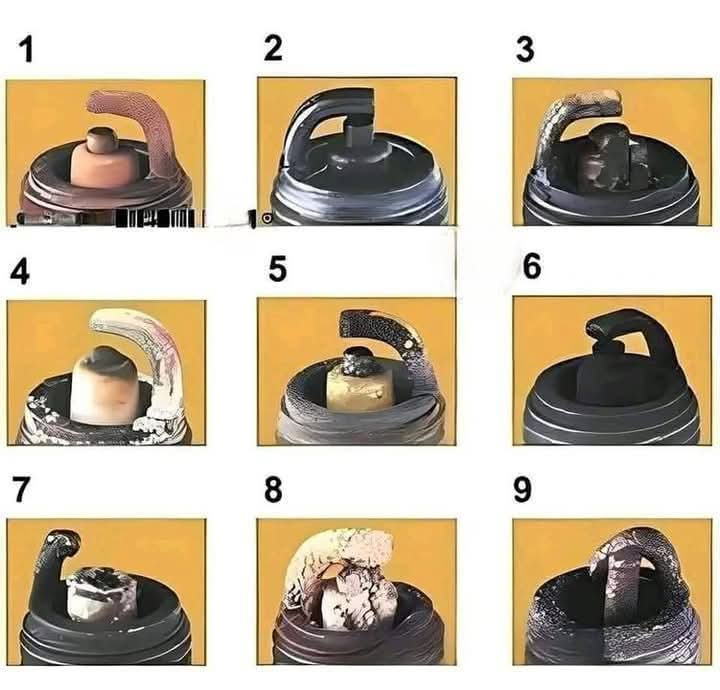
Visual reference of the 9 most common cases. Detailed descriptions follow.
1Good condition
Normal combustion
Light brown/gray electrode, thin deposits, clean insulator.
Actions
- No correction needed. Keep current heat range and gap.
- Replace at manufacturer’s service interval.
2Oil fouled
Oil from piston/segment issue
Black oily deposits, wet electrode.
Actions
- Check compression / leak-down test (rings, guides, valve seals).
- Check breather/PCV and oil level (overfill).
3Incorrect gap
Need to adjust spark plug gap
Abnormal wear, hard starts, misfires.
Actions
- Adjust gap with feeler gauge (OEM spec).
- Inspect distributor, ignition wires and coil.
4Very old plugs
Not replaced for a long time
Dark insulator, eroded electrodes, thick deposits.
Actions
- Replace plugs with a new set (same heat range).
- Note mileage and respect maintenance interval.
5Lead deposits
Fuel with high lead content
Yellowish/light gray glazed deposits.
Actions
- Switch to unleaded quality fuel (SP98/SP95-E5).
- Clean/replace plugs and check ignition timing.
6Carbon fouled
Incomplete combustion / rich mixture
Black, dry, powdery deposits.
Actions
- Check fuel pump/carb(s) & mixture, air filter, choke.
- Check intake leaks and ignition condition.
7Overheating
Engine temp above normal
White electrode, cracked insulator, possible melted tip.
Actions
- Check cooling (thermostat, fan, shrouds, too much advance).
- Verify plug heat range and mixture.
8Wrong fuel/heat range
Change fuel or inspect valves
Fragile deposits, knock/detonation traces appearing quickly.
Actions
- Switch to higher octane fuel (e.g. 95 → 98).
- If recent with low mileage: check valve clearance & sealing.
9Mechanical damage
Foreign object / chamber damage
Hammered electrode, chips, broken insulator.
Actions
- Immediate inspection of affected cylinder (endoscope if possible).
- Look for foreign object, damaged valve head, piston damage.
- Do not drive before complete diagnosis.
Maintenance best practices
- Respect OEM heat range and gap.
- Always check ignition timing, intake sealing and air filter.
- Replace plugs as a complete set and keep mileage history.


