 Français
 Español
 Deutsch


In the 1960s, everything speeds up: cars are everywhere, youth culture comes into its own, and surf and racing start shaping the collective imagination. EMPI arrives with a clear proposition: you can transform your Volkswagen. Better yet, you can transform it to reflect who you are.
What stands out when you look at these period ads is how consistent the story is. Each page is another step toward a VW that feels “different”: more personal, visually cleaner, sometimes more powerful, and often more desirable. EMPI isn’t selling a part number; the brand is selling a direction.

“Beauty With a Purpose” : practical style
With pages like “BEAUTY With a Purpose, Beautify your car, Protect your upholstery,” EMPI delivers a simple, highly effective double promise: enhance and protect. The tone is reassuring, almost domestic, but the impact is cultural: the interior becomes part of the “VW project.” It’s not just about driving; it’s about taking care of the car, making it cleaner, more pleasant, and more finished.
That’s a key point. EMPI helped legitimize the idea that a VW could be simple yet well cared for, and that aesthetics don’t stop at the bodywork.

“What the well dressed Volkswagen should wear”: the VW as a wardrobe
Another iconic page is “What the EMPI well dressed Volkswagen should wear.” The title says it all. EMPI turns the car into someone you can dress. The Beetle is presented like a silhouette, annotated, with a series of accessories positioned as “must-haves.”
This approach had a direct impact on the VW scene because it standardized the codes. It created an almost universal idea of a VW that’s well built, well set up, and well thought out. In other words, it helped establish a shared visual grammar, the one that would later let you recognize a style at a glance.
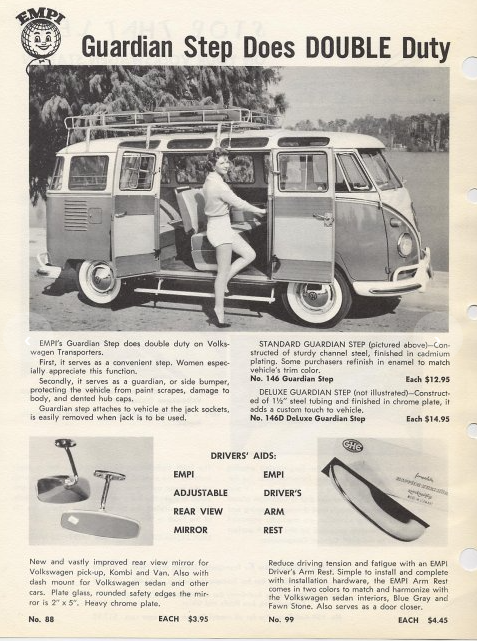
“Guardian Step Does DOUBLE Duty”: an accessory that truly delivers
When EMPI features a Bus with a Guardian Step promoted as “double duty,” the brand focuses on real-world use: stepping in more easily, protecting the vehicle, preventing dents and scrapes, and making day-to-day life simpler. The ad even expands into driver-comfort accessories (mirror, armrest), with a straightforward promise: reduce fatigue, improve comfort, and make the road feel easier.
Here, EMPI goes beyond “looks.” The brand reinforces a lasting idea in the VW world: the aftermarket isn’t a whim, it’s an upgrade to the overall experience. That message mattered to Bus culture in particular, from road trips and camping to weekend outings and everyday utility.
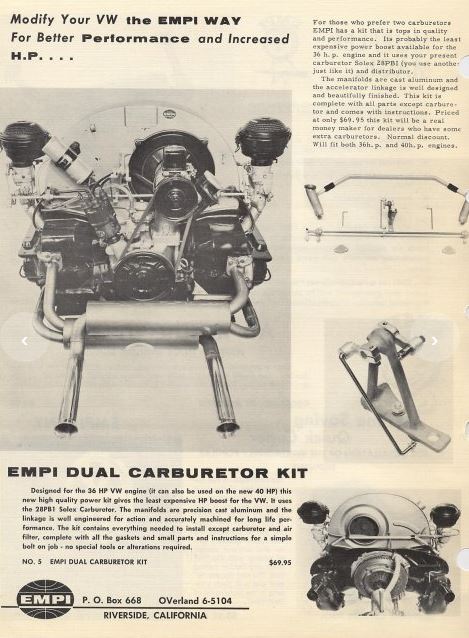
“Modify your VW the EMPI way”: making performance accessible
Then comes the performance angle, with a page whose title is almost a manifesto: “Modify your VW the EMPI way.” The wording alone is telling: EMPI isn’t offering just one option among many, but a method. The promise is clear, “better performance” and “increased H.P.,” and it’s made tangible by what the ad highlights: a dual-carburetor kit presented as a complete solution, designed to be understood and installed without ambiguity.
The key strength here isn’t only the advertised gain; it’s democratization. EMPI insists that improving performance can be “logical,” “controlled,” almost straightforward, as long as you have the right package. Visually, the page does everything to reduce uncertainty: you’re not looking at an abstract concept, you’re looking at the hardware, the related components, the assembly, and the coherence of the kit. The goal is clearly to turn tuning, often seen as complex, into a reassuring process: a short list, a clear logic, and an expected result.
This kind of advertising had a lasting impact on VW culture. It reinforced the idea that the Volkswagen is an evolvable platform, and that performance isn’t reserved for insiders. By selling a “ready” kit, EMPI also sells confidence: the confidence to take the leap without having to invent your own setup from scratch. That’s how a brand helps build a scene, by turning an ambition (going faster) into a well-marked path.
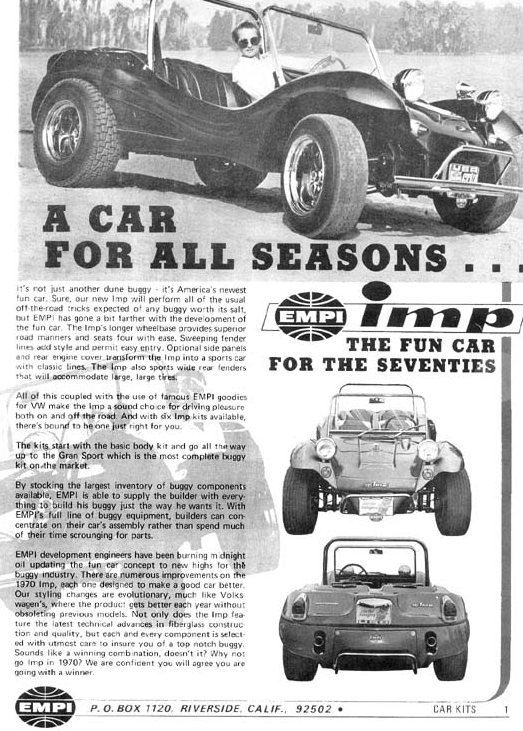
“A car for all seasons… EMPI Imp”
Some ads shift into a different register: projection. With “A car for all seasons… EMPI Imp, The fun car for the seventies,” EMPI is no longer selling a one-off upgrade; the brand is selling a whole new kind of experience. The message is unmistakably “1970s”: freedom, pleasure, style, and a car designed to break out of the usual mold, with one essential detail: the ad takes care to stress versatility. The EMPI Imp isn’t presented as a simple beach toy; it’s described as a vehicle that can feel at home both on the road and off it, and even handle everyday constraints (conditions, weather, real-world use).
The marketing is razor-sharp. EMPI ties the buggy to the idea of fun, while backing it up with arguments that make it feel credible and livable. And above all, the brand isn’t just selling a body; it’s selling a complete solution. The ad explains that kits are available at different levels, from basic to fully developed, and highlights a decisive advantage: EMPI saves you from the parts hunt. In other words, the brand isn’t only offering a product, but a shortcut: less guesswork, more coherence, and a faster path from dream to reality.
The “invisible” upgrade: when EMPI sold comfort (EMPI-VENT)
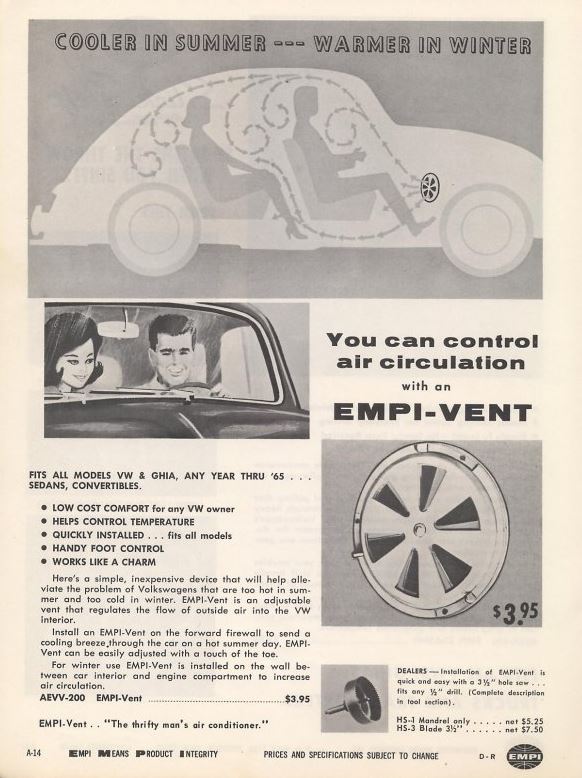
Even before talking about power, EMPI tackles something very concrete: everyday life inside the car. The EMPI-VENT ad promises a car that’s “cooler in summer, warmer in winter” by controlling airflow circulation. What’s interesting is that the message isn’t trying to impress; it’s trying to reassure. Quick installation, a foot-operated control, compatibility with VW and Karmann Ghia models “up to ’65,” and a strong selling point: all of it for just a few dollars, presented as “the thrifty man’s air conditioner.”
This kind of page says something essential about the era. EMPI wasn’t only selling dramatic transformations; it was also selling practical upgrades, the kind that make a VW more enjoyable every day. Culturally, that’s powerful: it reinforces the idea that optimizing a Volkswagen isn’t only about “going faster,” it’s about living better with your car.
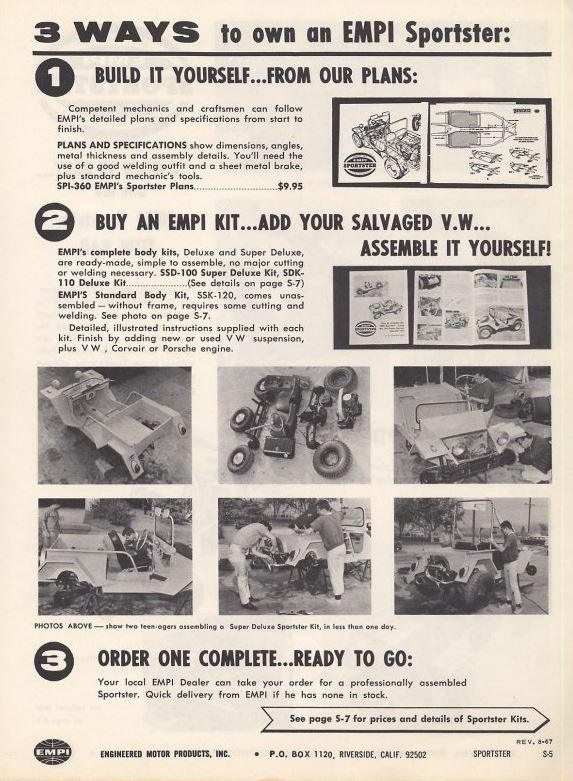
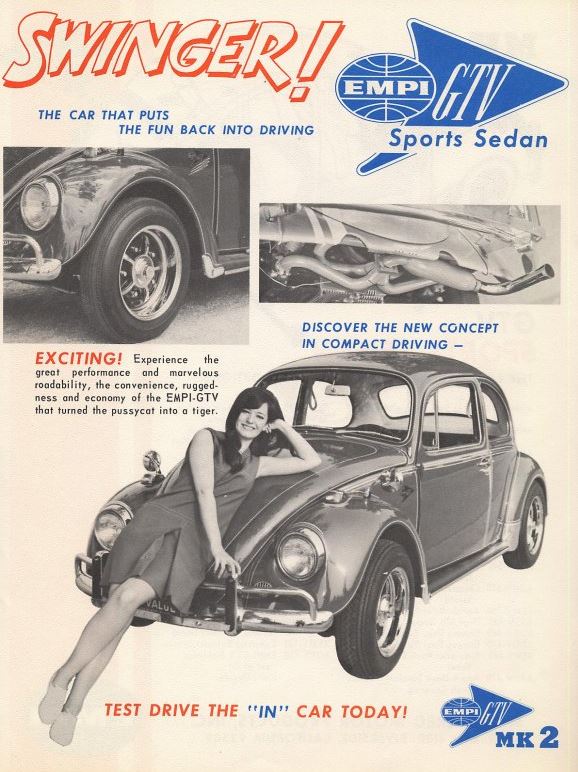
It’s easy to forget how much these pages mattered. Advertising doesn’t just reflect a trend, it accelerates it. EMPI helped normalize the idea that upgrading your VW wasn’t something marginal, but almost natural. And above all, that there was a “right” way to do it: clean, coherent, and confidently executed.
What these ads promised, some VWs actually embodied. Cars became rolling showcases where accessories weren’t hidden; they told the story of an era. That’s also why old EMPI advertisements still fascinate today: they’ve become reference points for building a car “in the spirit of its time,” faithful to the original visual codes and philosophy.
sources : www.oldspeed.net,cal-look.no
 Digg.com
 Stumbleupon.com
 Del.icio.us
 Facebook
 Reddit.com
 Radio Hole Cover Plate for VW Combi until 7.1966, Raw Metal Panel
 Set of 2 Serrated Urethane Bushings for Volkswagen Torsion Bar - 16-5132
 Rubber Tailgate Striker Wedge for VW Combi, 1963-1971, with Screws
 Foldable Bag - Volkswagen Van VW T1 Explore
 Left Wiper Arm Black for Beetle 1970-1972 - Bolt-Nut Fixing - Length: 260 mm


